
×
Overview of the 1 May 2025 Tenancy Law Changes
Click here to find out more and understand your rights

Tenants Queensland Rejects Push to Weaken Renting Laws for Developers

February 26, 2026

Tenants Queensland (TQ) strongly rejects the recent call from the Property Council of Australia (POA) to weaken tenancy laws in response to rising demand for student accommodation. Students are already struggling in a tight rental market, face soaring rents, low vacancy rates and intense competition just to secure a home.
 
These pressures mirror what renters across Queensland are experiencing every day though students, especially those in purpose-built accommodation experience specific vulnerabilities. Most are international students coming from countries with differing renting rules and both international and domestic students are often first-time renters not fully aware of their rights, making them particularly vulnerable to unfair terms and pressure.
 
The POA argues that changes to tenancy laws are needed to encourage more student accommodation development, despite acknowledging that Brisbane already has a “decent” pipeline of new supply underway.
 
Renter protections are not the barrier to new construction — and developers should not be permitted to use the housing crisis to pursue an agenda to weaken tenant rights.
 
TQ CEO, Penny Carr said, “Domestic and international students living in student accommodation are often living away from home for the first time, navigating an overheated rental market and unfamiliar systems. This leave them vulnerable, potentially coerced into contracts that are not to their benefit, and are unaffordable”.
 
For many years students have experienced the problem of inflexible contracts that extend well beyond the academic calendar, leaving them paying high rents after their study period or their study ends. Rather than seeking legislative changes, proprietors of purpose‑built student accommodation should focus on better tailoring their product to student needs.
 
Ms Carr continued, “Students need security, fairness, and affordable housing — not weaker rights or special rules that leave them even more exposed”.
 
TQ also firmly opposes any proposal to introduce a separate class of rental rules for students. Creating a two‑tier system would expose young people to weakened protections and greater risk of exploitation. All renters deserve strong, consistent safeguards, regardless of their age, country of origin, or education status.

TQ urges the Queensland Government to reject any industry‑driven proposals that would erode rental safeguards or carve out special rules for student accommodation. Housing solutions must support renters. Queensland needs more affordable homes, not fewer rights.

Alternatives Needed to Evicting and Excluding Public Housing Tenants

June 16, 2025

  
Tenants Queensland (TQ) is calling for caution regarding the introduction of the public housing ‘three strikes and you’re out’ policy, announced by the Housing Minister on Saturday.
 
TQ notes there are already legislated provisions to allow the eviction of social housing tenants after ‘one strike’ if the issue concerned is serious enough.
 
A common problem with many of these polices is they reduce the standard of proof required to determine an alleged breached, which is the case in the current law. Further, they often extend the responsibilities for social housing tenants beyond those of other renters, extending them to include the actions of people on neighbouring properties. Given most social housing tenants experience high levels of disadvantage and vulnerability, this is unreasonable.
 
TQ CEO, Ms Penny Carr, said, “Whilst we’re pleased to hear that there will be support where needed, the risk is that some social housing tenants will be evicted for behaviours that relate to the reasons they were originally housed, for example poor mental health, disability and social exclusion”.
 
“Further”, Ms Carr said, “to think that those evicted from social housing will be able to gain and sustain private rental for periods of up to two years is challenging. Those excluded are highly like to find themselves homeless and in need of support and temporary housing from other community services.“
 
These sort of polices have the potential to end up in a revolving door for the most vulnerable in our community. TQ calls for consultation on any changes to housing policy and procedure as well as direct and early information to public housing tenants.

Tenants Queensland welcomes the passage of the Bill – but there is more to be done

May 23, 2024

Tenants Queensland welcomes the introduction of the Residential Tenancies and Rooming Accommodation and Other Legislation Amendment Bill 2024.

Tenants Queensland CEO, Ms Penny Carr, said, “I have just come out of Parliament House and I have watched the passage of the Residential Tenancies and Rooming Accommodation and Other Legislation Amendment Bill 2024. It is a good day for renters, there are many good reforms in the package that will improve the situation for people living in rented homes across Queensland. But there are two more things that we have to do that were not in that package today:

1. We need to limits the amount rents can rise on an annual basis
2. We need to truly end termination of tenancies without grounds. That means removing the end of a fixed term as a reason to end a tenancy.

However today is a day for celebration and I want to congratulate the Government for all the good work that they have done to get this Bill through today.

Tenancy Law Reform Bill tabled – good start, more to do

March 22, 2024

Tenants Queensland (TQ) welcomes the Miles Government’s package of reforms that will improve the experiences of renters, with the introduction of the Residential Tenancies and Rooming Accommodation and Other Legislation Amendment Bill 2024


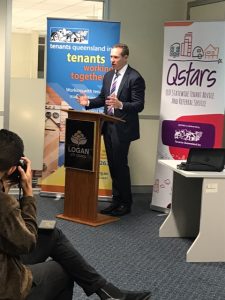
TQ CEO, Ms Penny Carr, said, “banning rent bidding, requiring a fee free way of paying rent, limiting what can be asked when signing up applying for a tenancy and controlling how and for how long information can be kept, will very much improve the experiences of renters across the state. We welcome these changes”.

Requiring evidence when the landlord wants to claim against the bond, the portable bond scheme and a rental code of conduct are changes also strongly supported by TQ. 

Despite welcoming the package TQ CEO, Ms Penny Carr, stated that there is more to be done. “The package is a good start but more needs to be done to support struggling renters”.

Read more

Tenancy reforms announced

February 4, 2024
Share House Icon

Tenants Queensland and QCOSS have jointly welcomed the package of tenancy reforms announced today by Premier Steven Miles as a promising first step towards improving the lives of Queenslanders living with rental insecurity.

The package is a positive sign that the Miles Government has listened to the pleas of Queensland’s renters and that it will continue to take seriously the plight of those burdened with insecure tenancies amid a cost-of-living crisis.

Tenants Queensland CEO Penny Carr says:
“Following three years of campaigning by Make Renting Fair in Queensland supporters, we particularly applaud the introduction of the following measures that will make a real difference in the lives of Queensland renters:

Read more

Queensland’s ageing population struggling to pay rent in regional areas – Media Release

January 17, 2018

Increasing numbers of elderly renters in regional areas are struggling to pay their rent particularly in areas around Bundaberg, Gympie, Moreton Bay and the Fraser Coast, according to the latest release of the Rental Vulnerability Index (RVI).

Tenants Queensland and City Futures Research Centre have released the Rental Vulnerability Index (RVI), as an indicator of rental vulnerability relative to social and economic pressures affecting Queensland renters.

This release highlights the availability of rental housing that is affordable on local incomes, social housing and marginal tenures such as boarding houses, as well as personal indicators including unemployment, low education, disability, single-parent households and both young and elderly renters.

The RVI identifies clusters of indicators to identify regions of ‘rental vulnerability’.

Updated figures released today incorporating the 2016 census data show areas of Somerset, Gladstone and Mackay making it into Queensland’s top 10 local government areas for rental vulnerability.

The data also shows that over the last five years, the proportion of older renters (over 65) has generally increased, with the highest proportions located in the regions.

Tenants Queensland CEO Penny Carr said some of the movement in rankings related to small fluctuations in populations and several postcode boundary changes.

She said the data highlighted that regional and remote parts of Queensland continue to indicate areas of highest rental vulnerability.

“This index is a timely reminder at the beginning of a new year that the elderly and low-income families in regional areas are struggling to pay their rent,” said Ms Carr who runs Queensland’s peak statewide tenant advisory service.

“The data is telling us that regional areas have a pressing need for services – such as tenant advice services – that give vulnerable households material assistance in dealing with housing problems.

“These places have high rates of unemployment, disability, low education and older people in rental housing.

“They also have high incidence of rental stress – even though median rents are low compared to Brisbane.”

Read more

Moves for rental properties to meet new minimum standards welcomed

October 25, 2017

Tenants Queensland (TQ) has welcomed the Palaszczuk government’s new laws designed to introduce minimum standards in rental properties and provide greater consumer protections for manufactured homes owner-occupiers.

TQ CEO Penny Carr said that introducing a head of power to regulate minimum standards in rental properties was a very positive step forward.

“Minimum standards in rental properties are particularly important when you consider that half of the renting households are families with children,” Ms Carr said.

“The legislation will also address the very poor quality of some rental accommodation in the state.

“Minimum standards are good for tenants who often fear asking for repairs and maintenance.

“Equally, they’re good for real estate agents and industry, particularly when dealing with unscrupulous lessors. Those lessors with properties which meet community standards have nothing to be concerned about.”

Read more

Tenants Queensland welcomes continued funding for the QSTARS program!

October 19, 2017

Queensland’s renting households will maintain access to free tenancy advice.  Today Minister for Housing and Public Works and Minister for Sport, the Hon Mick de Brenni, pledged $37.597 million for five years from June 2018 for the Queensland Statewide Tenant Advice and Referral Service (QSTARS).

QSTARS has helped tens of thousands of Queensland renting households since the program commenced on 1 October 2015 but until today the future of the program was unclear with the current contract ending in June 2018.

As managers and deliverers of the program, Tenants Queensland welcomes the announcement saying it will provide comfort to half a million renters throughout Queensland to know that the growing service would continue.

“Renters in all regions of the state contact QSTARS for advice and support to meet their tenancy responsibilities and exercise their rights,” said TQ CEO Ms Carr.

Read more

We launched the first ever Rental Vulnerability Index!

May 18, 2017

Check out the rental vulnerability where you live!  

Today Housing Minister Mick de Brenni helped Tenants Queensland launch the first ever Rental Vulnerability Index (RVI), a tool which allows you to see how many vulnerable renters there are in any postcode area in Queensland.

The RVI is more than just a measure of affordability; it is a look into who lives in the local rental housing and what sort of other vulnerabilities they might experience. It combines 13 data sources, each of which individually expose a potential to experience a housing problem, into one measure of overall rental vulnerability.

Using the interactive map, you can identify not just the RVI for each Queensland postcode area, you can also see the statistics on each of those 13 indicators.

This RVI has been developed as primarily as a service planning tool for tenant advisory services – to ensure that need for services align with demand and if not to reach out to the most vulnerable tenants. However, it will have applicability for a much broader range of service providers, policy maker and planners.

Check out your postcode!